

Adrienne Arsht Center for the Performing Arts of Miami-Dade County presents
Academy of St Martin in the Fields With Joshua Bell
Joshua Bell, Music Director and Violin
Charles Ives
(1874-1954)
arr. Iain Farrington
Variations on "America"
Camille Saint-Saëns
(1835-1921)
Violin Concerto No. 3 in B minor, Op. 61
I. Allegro non troppo
II. Andantino quasi allegretto
III. Molto moderato e maestoso; Allegro non troppo
Joshua Bell, violin
—Intermission—
Robert Schumann
(1810-1856)
Symphony No. 1 in B-flat major, Op. 38 ("Spring")
I. Andante un poco maestoso; Allegro molto vivace
II. Larghetto
III. Scherzo: molto vivace
IV. Allegro animato e grazioso
Variations on "America"
Charles Ives (1874-1954)
The New Yorker describes Charles Ives as a "connoisseur of chaos." Writer and pianist Jeremy Denk calls him "the crazy and brilliant patriarch of American music." To Jamie Berstein, daughter of conductor and composer Leonard Bernstein, "Everything about Charles Ives is unusual."
To be sure, Ives stands alone as this country's life-insurance magnate turned pioneering composer. He was widely dismissed as an amateur and a dilettante during his lifetime, but nonetheless won the Pulitzer Prize for Music. He expressed dumb, ugly views on women and homosexuals, but, according to Denk, "wrote some of the most beautiful American music—at times, passages of jaw-dropping, seductive refinement." Ives embraced dissonance in his music and flinched when listeners responded with noise of their own.
"Except for his wife and a few enthusiasts, most of Ives' contemporaries, in particular local musicians, assumed that his music was either a bad joke or the work of a crank," music critic David Schiff wrote in a 1997 essay for The Atlantic. "Ives was surprised and disturbed by their incomprehension."
Ives was not the kind of artist to suffer negative reviews in silence. In 1920, he published the score for his landmark second piano sonata, aka "Concord, Mass., 1840-1860"—the Concord Sonata. Sensing that his haters would come for him even if the piece didn't involve 45 minutes of atonal effects, harmonic pile-ons and movements named for the great transcendentalists (Emerson, Hawthorne, the Alcotts, Thoreau), Ives wrote a book-length defense titled Essays Before a Sonata.
"These prefatory essays were written by the composer for those who can't stand his music—and the music for those who can't stand his essays," Ives wrote in an introductory footnote. "[To] those who can't stand either, the whole is respectfully dedicated." The Concord Sonata would not be performed in full for 18 years.
Ives' Variations on "America" found a much quicker path to an audience. He wrote the piece in 1891 and debuted it in 1892 at the church where the then teenager served as organist. Ives is said to have claimed that playing the piece, which includes five variations on the patriotic tune "America (My Country, 'Tis of Thee)," offers as much fun as a game of baseball.
America and its pastime were far different entities in the 1890s, yet one suspects the multivalence of the composition's title did not escape Ives. But did he appreciate it? Denk has described Variations on "America" as "cheeky satire," though other critics have cautioned against mistaking the work's jaunty nature for anything but red-blooded patriotism. After all, a few years after introducing Variations, Ives worked elements of "America the Beautiful" and other flag-waving songs into his Second Symphony.
In a 2024 blog post, Jamie Bernstein notes that whatever spirit of amity Ives may have felt while writing his early works had curdled into antisocial behavior by the time her father conducted the Second Symphony in its 1951 premiere at Carnegie Hall.
"By then, Charles Ives had become a full-blown curmudgeon who had grown thoroughly and justifiably annoyed by the music world's lack of respect for his innovative approach to composition," Bernstein writes. "He declined to attend the premiere. But friends and family members finally persuaded him to at least listen to the radio broadcast at a neighbor's kitchen. What he heard so elated him that, according to my father, Charles Ives went home and—cut off his beard. I guess at the age of 77, that could be the equivalent of kicking up your heels and yelling, 'Wahoo!!' "
Violin Concerto No. 3 in B Minor, Op. 61
Camille Saint-Saëns (1835-1921)
Can a piece of music change a person's life? Marcel Proust thought so. In Swann's Way, the first volume in the French novelist's monumental In Search of Lost Time, the title character, Charles Swann, attends a party at which he hears a sonata performed on piano and violin. He considers himself musically ignorant, and is confused by the impression the work—a "little phrase" from it, to be exact—has on him. Nonetheless, he recognizes its authenticity and power. The music "open[ed] up before Swann the possibility of a sort of rejuvenation," Proust writes, "[and] the possibility, hitherto beyond all hope, of starting to lead belatedly a wholly different life." Swann, who has long felt aimless and withdrawn, is invigorated by "a sort of liquid rippling of sound." Right then, he decides to stop "taking refuge in trivial considerations" and become a more serious and open person.
Since the publication of Swann's Way in 1913, the inspiration for Vinteuil, the fictional composer who created the novel's sonata, has been a matter of debate, with readers and amateur sleuths claiming Proust was nodding toward everyone from Schubert to Wagner. In 2017, a pair of Russian-born musicians, sisters Maria and Nathalia Milstein, made headlines by releasing an album and two short films that argue French composer Gabriel Pierne was the real Vinteuil. All this despite the fact that Proust strongly suggested in letters and early manuscripts that the composer on which he based Vinteuil was another contemporary and compatriot: Camille Saint-Saëns.
Born in 1835 in Paris, Saint-Saëns was known for being a child prodigy and an adult grouch; he voiced withering disdain for the work of composers such as Debussy, Wagner and Stravinsky. (At the 1913 premiere of The Rite of Spring in Paris, Saint-Saëns reportedly uttered, "If that's a bassoon, I'm a baboon.") Saint-Saëns was so charitable with his criticism that he even extended it to himself. He considered his Carnival of the Animals suite to be lightweight and forbade its publication during his lifetime. It's now among his most popular works.
Saint-Saëns was, of course, capable of releasing grace and beauty into the world. His Symphony No. 3 in C minor, Cello Concerto No. 2 and opera Samson et Delila can leave a listener feeling Proustian levels of astonishment.
"Saint-Saëns knows how to build drama," violinist Benjamin Beilman told The Strad magazine of the composer's Violin Concerto No. 3 in B minor. Saint-Saëns dedicated the work, which he wrote in 1880, to Pablo de Sarasate, a Spanish violinist with whom he occasionally collaborated.
"It's seen as a violin showpiece," Beilman explained, "like an athletic feat of sorts. ... [Y]ou have to play it with a certain bravura and conviction."
Will Saint-Saëns' concerto change your life? Will it lead you, Swann-like, "towards a state of happiness that [is] noble, unintelligible, yet precise"? Perhaps. But first, it may make you sweat.
Symphony No. 1 in B-flat Major, Op. 38 ("Spring")
Robert Schumann
Robert Schumann appeared to have spent his life beset by one agony after another. As a teenager, he lost his father and sister in a single month, likely contracted a terminal case of syphilis and is believed to have ruined his hands—along with his hopes of becoming a piano virtuoso—through an odd series of finger-strengthening exercises. He may also have been bipolar and almost certainly suffered from depression.
Since his death in an asylum in 1856, Schumann has been the subject of all manner of speculation and debate. One theory posits that he paralyzed the fingers in his right hand not by sticking them inside a weight-bearing contraption (though he reportedly did this), but because he’d poisoned himself with mercury—which he was taking to treat his syphilis. Most of the arguments surrounding Schumann concern what effect the composer’s sea of troubles had on his work, and how his listeners should feel about it.
“Though it’s dangerous to romanticize mental illness,” music critic Anthony Tommasini wrote in The New York Times, “one can’t help thinking that Schumann’s unhinged imagination, counterbalanced by a probing musical intellect, led to some of the Romantic era’s most original music.”
The raw, personal nature of Schumann’s work, along with his avowed erraticism, has long unsettled conventional listeners, and countless articles and essays about the composer describe his music as being an acquired taste. Even Leonard Bernstein, in a 1953 lecture, outlined popular gripes about Schumann—his romanticism, his supposed inability to orchestrate well, the relative weakness of his symphonies—before the conductor stood forth as one of his strongest advocates.
“Schumann is one of those special tastes that can send casual shipboard acquaintances rushing into each other’s arms,” Bernstein said, “or it can make enemies of otherwise loving friends. But nobody will deny Schumann’s great gifts: the inspired lyricism that soars out of his best works, the uncanny stream of newnesses that succeed each other in such profusion, the warmth, the singing tides, the rhythmic ingenuities and the daring experimentalism.”
— Jake Cline
Joshua Bell

Photo courtesy Ben Ealovega.
With a career spanning almost four decades, Grammy Award-winning violinist Joshua Bell is one of the most celebrated artists of his era. Bell has performed with virtually every major orchestra in the world, and continues to maintain engagements as a soloist, recitalist, chamber musician and conductor.
In the 2025-26 season, Bell continues to champion the rediscovered Violin Concerto by Thomas de Hartmann, following his recent Diapason D’Or-winning world premiere recording of the work. After giving its UK premiere at London’s BBC Proms, he performs the concerto with the New York Philharmonic, Boston Symphony and Oslo Philharmonic, and gives its Canadian premiere during his season-long tenure as a Toronto Symphony Spotlight Artist.
With the Academy of St Martin in the Fields, he leads extensive tours on both sides of the Atlantic, including returns to the Vienna Konzerthaus and New York’s Carnegie Hall. Other orchestral highlights include his first appearances as principal guest conductor of the New Jersey Symphony; concerto dates with the Houston Symphony, Oregon Symphony, Baltimore Symphony, Naples Philharmonic and Ottawa’s National Arts Centre Orchestra; and concerts and an Asian tour with Hamburg’s NDR Elbphilharmonie Orchestra. As well as giving recitals in the US and Europe, Bell joins Steven Isserlis and Evgeny Kissin for trio programs in New York, Kansas City, Paris, Vienna and Prague, and reunites with Jeremy Denk for duo recitals at Walt Disney Concert Hall and the Ravinia Festival.
In 2011, Bell was named music director of the Academy of St Martin in the Fields, succeeding Sir Neville Marriner, who formed the orchestra in 1959. Bell’s history with the Academy dates to 1986, when he first recorded the Bruch and Mendelssohn concertos with Marriner and the orchestra. Bell has since led the orchestra on several albums, most recently Bruch: Scottish Fantasy, which was nominated for a 2019 Grammy Award. In April 2024, the Academy announced the extension of Bell's music director contract through the 2027-28 season.
Bell has commissioned and premiered new works by John Corigliano, Edgar Meyer, Behzad Ranjbaran and Nicholas Maw—his recording of Maw’s Violin Concerto received a Grammy Award. In 2023-24, Bell introduced his newly commissioned concerto project, The Elements, a suite featuring movements by five renowned living composers: Jake Heggie, Jennifer Higdon, Edgar Meyer, Jessie Montgomery and Kevin Puts. The work received its premiere performances with the NDR Elbphilharmonie Hamburg, Hong Kong Philharmonic, New York Philharmonic, Chicago Symphony Orchestra and Seattle Symphony Orchestra.
Bell has collaborated with peers including Renée Fleming, Daniil Trifonov, Emanuel Ax, Lang Lang, Chick Corea, Regina Spektor, Chris Botti, Anoushka Shankar, Dave Matthews, Josh Groban and Sting, among others.
In 1998, Bell worked with composer John Corigliano on the film soundtrack for The Red Violin, which elevated Bell to a household name and garnered Corigliano an Academy Award. Since then, Bell has appeared on several other film soundtracks, including Ladies in Lavender (2004) and Defiance (2008). Bell commemorated the 20th anniversary of The Red Violin in 2018-19, bringing the film with live orchestra to various festivals and the New York Philharmonic.
Bell appeared three times as a guest star on The Tonight Show With Johnny Carson and made numerous appearances on the Amazon series Mozart in the Jungle. He is also featured on six Live From Lincoln Center specials, as well as a PBS Great Performances episode, Joshua Bell: West Side Story in Central Park. In summer 2020, PBS presented Joshua Bell: At Home With Music, a nationwide broadcast produced entirely in lockdown, by Tony and Emmy Award-winning director Dori Berinstein. In August 2020, Sony Classical released the companion album to the special, Joshua Bell: At Home With Music (Live).
For his contributions to music education, Bell received the 2022 Paez Medal of Art, bestowed by the Venezuelan American Endowment for the Arts and the 2019 Glashütte Original Music Festival Award, presented in conjunction with the Dresden Music Festival. In 2021, Bell announced his new partnership with Trala, the tech-powered violin learning app. Bell maintains additional active involvement with Education Through Music and Turnaround Arts, and in 2014, mentored and performed alongside National YoungArts Foundation string musicians in an HBO Family Documentary special, Joshua Bell: A YoungArts Masterclass.
Bell’s ongoing partnership with Embertone, the leading virtual instrument sampling company, on the Joshua Bell Virtual Violin, a sampler created for producers, engineers, artists and composers, is widely considered the best virtual instrument of its kind. Bell also collaborated on the Joshua Bell VR experience with Sony PlayStation 4 VR, which features Bell performing with pianist Sam Haywood in full 360-degrees VR.
As an exclusive Sony Classical artist, Bell has recorded more than 40 albums, garnering Grammy, Mercury, Gramophone and OPUS KLASSIK awards. Bell's 2023 release, Butterfly Lovers, features the eponymous Violin Concerto by Chen Gang and He Zhanhao, newly arranged for a traditional Chinese orchestra conducted by Tsung Yeh. Bell’s 2019 Amazon Originals Chopin Nocturne arrangement was the first classical release of its kind on Amazon Music. Bell’s 2013 album with the Academy of St Martin in the Fields, featuring Bell directing Beethoven’s Fourth and Seventh Symphonies, debuted at No. 1 on the Billboard charts.
In 2007, a Pulitzer Prize-winning Washington Post story, centered on Bell performing incognito in a Washington, D.C., metro station, sparked an ongoing conversation regarding artistic reception. The feature inspired Kathy Stinson’s 2013 children’s book, The Man With the Violin, and an animated film with music by Academy Award-winning composer Anne Dudley. Stinson’s subsequent 2017 book, Dance With the Violin, illustrated by Dušan Petričić, offers a glimpse into one of Bell’s competition experiences at age 12. Bell debuted The Man With the Violin festival at the Kennedy Center in 2017, and, in March 2019, presented a Man With the Violin family concert with the Seattle Symphony.
Born in Bloomington, Indiana, Bell began playing the violin at age 4, and at age 12, began studies with his mentor, Josef Gingold. At age 14, Bell debuted with Riccardo Muti and the Philadelphia Orchestra, and made his Carnegie Hall debut at age 17 with the St. Louis Symphony. At age 18, Bell signed with his first label, London Decca, and received the Avery Fisher Career Grant. In the years following, Bell has been nominated for six Grammy Awards, named “Instrumentalist of the Year” by Musical America, deemed a “Young Global Leader” by the World Economic Forum and received the Avery Fisher Prize. He has also received the 2003 Indiana Governor’s Arts Award and a Distinguished Alumni Service Award in 1991 from the Jacobs School of Music. In 2000, he was named an “Indiana Living Legend.”
Bell has performed for three American presidents and the justices of the Supreme Court of the United States. He participated in former president Barack Obama’s Committee on the Arts and Humanities’ first cultural mission to Cuba, joining Cuban and American musicians on an Emmy-nominated PBS Live From Lincoln Center special, Joshua Bell: Seasons of Cuba, celebrating renewed cultural diplomacy between Cuba and the United States.
Bell performs on the 1713 Huberman Stradivarius violin.
Academy of St Martin in the Fields

Photo courtesy Richard Lea-Hair.
Founded in 1958 by Sir Neville Marriner, the Academy of St Martin in the Fields has evolved into a musical powerhouse, an orchestra renowned across the world for its commitment to the musical freedom of its players and the sharing of joyful, inspiring performances. Today, with music director Joshua Bell, ASMF’s player-led approach empowers every member of the orchestra. This creates a direct line and electrifying connection between the orchestra and its audiences, resulting in ambitious and collaborative performances that transcend the more traditional conductor-led model.
ASMF will present its most ambitious season of the past decade in 2025-26 by continuing to collaborate with the world’s great soloists and directors, including music director Joshua Bell, Jan Lisiecki, Steven Isserlis, Arthur and Lucas Jussen, Elena Urioste and Khatia Buniatishvili alongside exciting rising stars such as Arielle Beck. The orchestra also embarks on its most significant international season of the past decade, including four tours to the United States, ASMF’s return after 20 years to New York’s Carnegie Hall and four separate tours to countries across Europe.
ASMF welcomes the second year of its partnership as principal orchestral partner at the Church of St Martin-in-the-Fields with a season of concerts launching with a BBC Radio 3-broadcast performance with the inaugural ASMF BBC New Generation Associate Julius Asal. Further concerts include a celebration of the film Amadeus, the world premiere of a new symphony from Eleanor Alberga and a celebration of the 70th birthday of composer and former ASMF orchestra member and composer-in-residence Sally Beamish.
Beyond the concert hall, the Academy's commitment to a social purpose manifests in impactful projects that harness the power of music to empower people. The Academy has a longstanding history of work that connects with people experiencing homelessness, and its education projects develop autonomy and creativity among emerging musicians worldwide.
The Academy's collective artistic responsibility fosters enduring collaborations with world-renowned soloists, exemplified by its 15-year partnership with Bell. These collaborations showcase the benefits of trust and true artistic collaboration developed over time.
Building on its rich global legacy, the Academy remains one of the world’s most recorded orchestras, igniting a love for classical music in people around the world through live performance and digital initiatives. Today, it continues a busy international touring program alongside a significant presence in the UK, making it one of the country’s most celebrated cultural exports.
Academy of St Martin in the Fields
Academy of St Martin in the Fields Administration
Chief Executive Officer, Annie Lydford
Executive Director, Performance & Planning, Tim Davy
Head of Concerts & Tours, Hannah Bache
Concerts & Tours Manager, Anna Galloway
Orchestra Personnel Manager, Charlotte Templeman
Performance & Projects Assistant, Esme Sullivan
Project Manager, Alex Tighe
Stage Manager (US Tour 2026), Michael Pattison
Stage Manager (Vail, CO and Winona, MN), Hal Hutchison
Librarian, Helen Harris
Director of Development & External Affairs, Chris Martin
Head of UK Development, Amy Scott
Development Manager (American Friends), Georgina Hamilton
Marketing & Communications Manager, Rose Hall
Development & Marketing Coordinator, William Lloyd
Head of Social Purpose, Callum Given
Head of Audiences and Community, Charlotte Cosgrove
Finance Manager, Philip Knight
Academy of St Martin in the Fields
For Opus 3 Artists
Robert Berretta, Managing Director
Benjamin Maimin, Chief Operating Officer
Jemma Lehner, Associate Manager
Miles Bentley, Associate
Leslie Beatrice, Director, Marketing & Creative
For the Academy of St Martin in the Fields US Tour
Leonard Stein, Consulting Producer
Peter Katz, Manager, Touring Logistics
John Pendleton, Company Manager
The position of Music Director of the Academy of St Martin in the Fields is generously supported by the Berry Charitable Foundation.
ASMF’s work in the USA is kindly supported by the American Friends of the Academy of St Martin in the Fields (President, Maria Cardamone).
Find out more about the Academy of St Martin in the Fields and keep in touch at ASMF.org.
Joshua Bell appears by arrangement with Park Avenue Artists (ParkAvenueArtists.com) and the Academy of St Martin in the Fields. Mr. Bell records exclusively for Sony Classical—a MASTERWORKS label.
Exclusive Management for the Academy of St Martin in the Fields: OPUS 3 ARTISTS
250 West 34th St., WorkLife Office Suite 313, New York, NY 10119 Opus3Artists.com
Classical Conversations
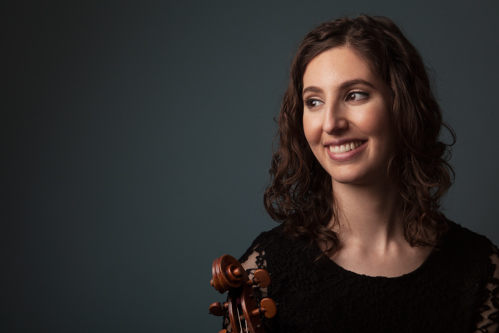
Photo courtesy Jacqueline Jove.
Identified as a “changemaker in the field,” violinist Jacqueline Jove occupies a unique position at the forefront of the music industry as a performing artist, leader and educator. She has been praised as an “expressive and masterful violinist” who brings both “sensitivity and thoughtful musicianship” and “sparkling energy and flair” to her performances and continues to appear in solo and chamber music settings across the country.
A passionate educator and administrative leader, Dr. Jove served as director of education of the Sphinx Organization, whose mission is to transform lives through the power of diversity in the arts. In this role, she directed and curated all programming for the Sphinx Performance Academy, a solo and chamber music intensive for young artists, in partnership with the Curtis and Cleveland Institutes of Music and The Juilliard School. She currently serves as director of dducation at the Adrienne Arsht Center for the Performing Arts and maintains a private teaching studio.
Dr. Jove holds degrees from Yale and SUNY and an Executive Leadership Certificate from the Global Leaders Program. She completed her Doctor of Musical Arts degree at the Frost School of Music under a full scholarship as a teaching assistant and Henry Mancini Institute Fellow. Her research focuses on the violin concert pieces of Cuban-French virtuoso and pedagogue José White. Dr. Jove is passionate about languages. She is fluent in English, Spanish and French and continues to improve her Portuguese and Hebrew language skills.
Donations help the Arsht transform lives by connecting our community to the arts. Make a gift today at ArshtCenter.org/Gift.
Postshow Survey
Your feedback is important to us. Please complete a brief survey about your recent Arsht experience.
Presenting Sponsor

Supporting Sponsors




Institutional Sponsors


Adrienne Arsht Center
Inspirational Bon Mot Series by Adrienne Arsht