


Everybody's 'Gatsby'
What does F. Scott Fitzgerald's novel have to say to our roaring, raging '20s? Everything.

by Jake Cline
One hundred and one years after its publication, The Great Gatsby remains, to quote another literary classic, unstuck in time. F. Scott Fitzgerald’s short, elliptical novel reflects the age in which it was written but addresses, not always kindly, every era that has followed. It stands atop history bracing for a fall, its anxiety betrayed by the incredulous title character’s most tragic declaration: “Can’t repeat the past? Why of course you can!”
The novel’s intrinsic durability was not always acknowledged. The book was a critical and commercial failure during Fitzgerald’s lifetime, although the author understood that only the latter aspect corresponded with reality; he knew that he had written the best American novel of his generation. “Some day they’ll eat grass, by God!” historian Sarah Churchwell quotes Fitzgerald saying of his critics in her 2013 book Careless People: Murder, Mayhem, and the Invention of The Great Gatsby. “I think now that I’m much better than any of the young Americans without exception.”
Lionel Trilling, in his landmark 1950 work of literary criticism The Liberal Imagination, became one of Fitzgerald’s most prominent champions. “The Great Gatsby after a quarter-century is still as fresh as when it first appeared," Trilling wrote. "It has even gained in weight and relevance, which can be said of very few American books of its time.”
More recently, in his 2020 book Under the Red White and Blue: Patriotism, Disenchantment and the Stubborn Myth of The Great Gatsby, critic Greil Marcus argues that Fitzgerald’s novel is “a book that for generations has exerted a gravitational pull so insistent that it can seem to have colonized the imagination both of its own country and of people imagining that country from anywhere else.”
What, then, does a book set in 1922 have to say to the roaring—or, more precisely, raging—’20s in which we live? Well, because we behave more or less as we always have, everything. Few American novels interrogate the character of the nation's citizenry with as much (to again quote Trilling) “specifically intellectual courage” as The Great Gatsby does. Herman Melville’s Moby-Dick, Mark Twain’s The Adventures of Huckleberry Finn and Toni Morrison’s Beloved are the novel's closest peers, as each of these works expresses the deepest fidelity to the self-evident truths the Founders enumerated in the Declaration of Independence and rightly prosecutes all of us for having ever averted our gaze from them. "There's a way in which you can see every American story as a version of the Declaration of Independence," Marcus writes, "every story an attempt to make it true, or prove it a lie."
The musical adaptation of The Great Gatsby that will appear at the Adrienne Arsht Center January 12-17 preserves the story's fundamental architecture and morality: In the fall of 1922, at the height of the Jazz Age, a mysterious, new-money millionaire (Jay Gatsby) begins hosting extravagant parties in his Long Island mansion in an attempt to draw the attention of his lost love (Daisy Buchanan), a former Midwesterner who lives across the bay and is married to an adulterous, old-money misogynist (Tom Buchanan). At first witnessing and soon abetting it all is the woman's new-in-town cousin and the novel's narrator (Nick Carraway). By the story's end, Gatsby and two others will be dead. Fitzgerald presents their violent deaths as inevitable, though the world in which they've fallen deprives them of consequence and justice. The Great Gatsby owes much of its fame to its examination of American mythmaking and dissembling, but the novel also provides a subtle indictment of American denialism: How will we ever see ourselves clearly if we keep shading our eyes?
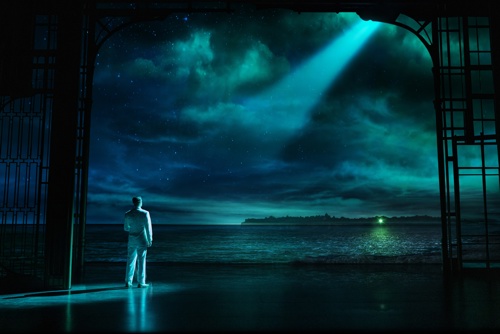
Fitzgerald's literary and philosophical ambitions inform the musical, which premiered on Broadway in 2024 and won a Tony Award for its costume design. But the show, which bears notable changes in its multipart narration and the elevation of its female characters, draws much from the novel's historical context to connect with the present day, says Kait Kerrigan, a New York-based playwright who wrote the musical's book. (See interview.)
"There are two things about The Great Gatsby that I think are really interesting," Kerrigan says in a phone interview. "One is that it was a story that took place at the beginning of modernism, which is one of my favorite periods of literature. And the reason I love it so much is because it feels so connected to the world that we live in right now. It feels like it's speaking to the future, because these novels were written in a time where the feeling was one of nostalgia, mixed with a sense of time moving faster than it had ever moved before. This was the advent of telecommunications. This was the beginning of people being able to travel across the country and even over the sea in airplanes. There are huge changes happening. Silent movies were starting. Everything felt like it was going faster and happening faster than it had ever happened before. And that's something that I think we identify with emotionally now.
"And then, the other part of it that I think is interesting is that the book is set in 1922. And in 1921, women fought for and won the right to vote in America. And so it's an interesting moment to be a woman in that story. That is not something that's explored in the novel, but from my perspective, looking back on it, I think it's an interesting moment to look at what marriage meant to these women. And in every case, the women in the story are grappling with what marriage means to them."
Leslie A. Fiedler, the late literary critic whose 1960 book Love and Death in the American Novel was reissued this year, might have agreed with Kerrigan's adaptation, which also emphasizes the role of economic class in American life then and now. (The musical, Kerrigan says, elides Tom Buchanan's racism in order to keep the focus on that theme.) Gatsby and the other young men in the novel, Fiedler argues, fail to see the women in their lives as anything more than symbols, as "they are in quest not of art and experience and the shudder of guilt, but of an even more ultimate innocence, an absolute America: a happy ending complete with new car, big house, money and the girl."
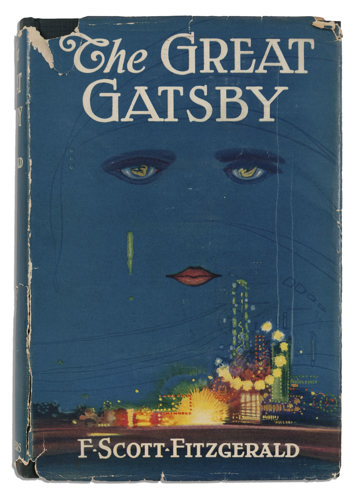
Fiedler's and Kerrigan's interpretations of The Great Gatsby are correct because no serious analysis of Fitzgerald's novel can be incorrect. The book's mysteries are unsolvable, its characters unreliable, and yet nothing within its pages is unrecognizable. Nick Carraway's claim that "I am one of the few honest people that I have ever known" reads as an outrageous lie only because he said it and we didn't. If Nick and his cohort—to say nothing of the novel's 1920s readership—couldn't see the diagnosis embedded within that falsehood (or maybe they could!), their creator certainly did. "The Great Gatsby is absolutely unique in American literature," Fiedler told the online magazine Salon in 2003. "It's the only neatly organized book written by an American."
Kerrigan admits to pursuing a more universal and less allusive approach in her version of The Great Gatsby: "It's always nice to be able to look at your story and say, 'OK, well, what's the broadest lens? What is the thing that is most universal about it? What is the thing that everybody can get on board with and that everyone will resonate with?'
"There's so much room to interpret this story and to interpret it many different ways," she adds. "I think that's exciting. That's wonderful. It is that kind of universal story. It asks to be interpreted."
The Great Gatsby appears January 12-17 in the Ziff Ballet Opera House. Tickets are available here.
jcline@arshtcenter.org